david-james.me/gov
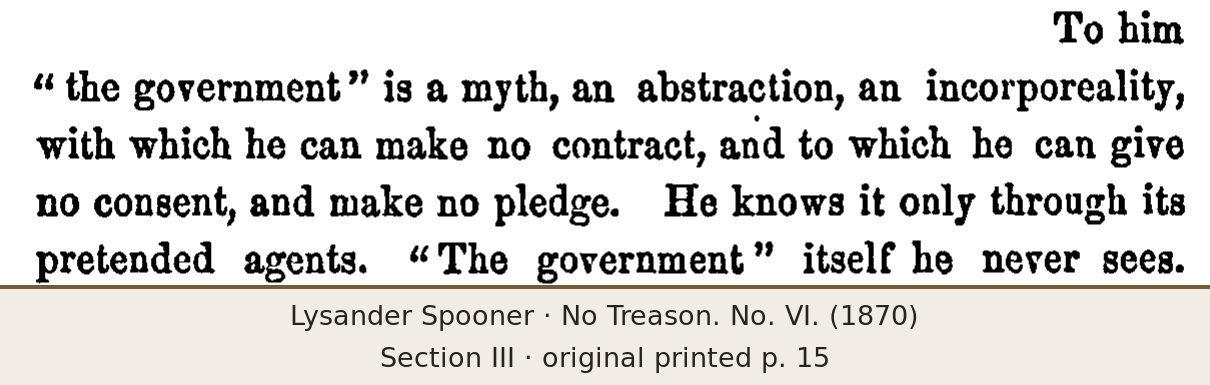
government is not a thing; it is an abstraction; it is pretended by some of man kind;
historian’s argument — exact words “Government requires make-believe.” Edmund S. Morgan, Inventing the People: The Rise of Popular Sovereignty in England and America, p. 13;
Government is not a thing, it does not exist and attributing deeds done by “government” is a falsehood, see prosopopoeia;
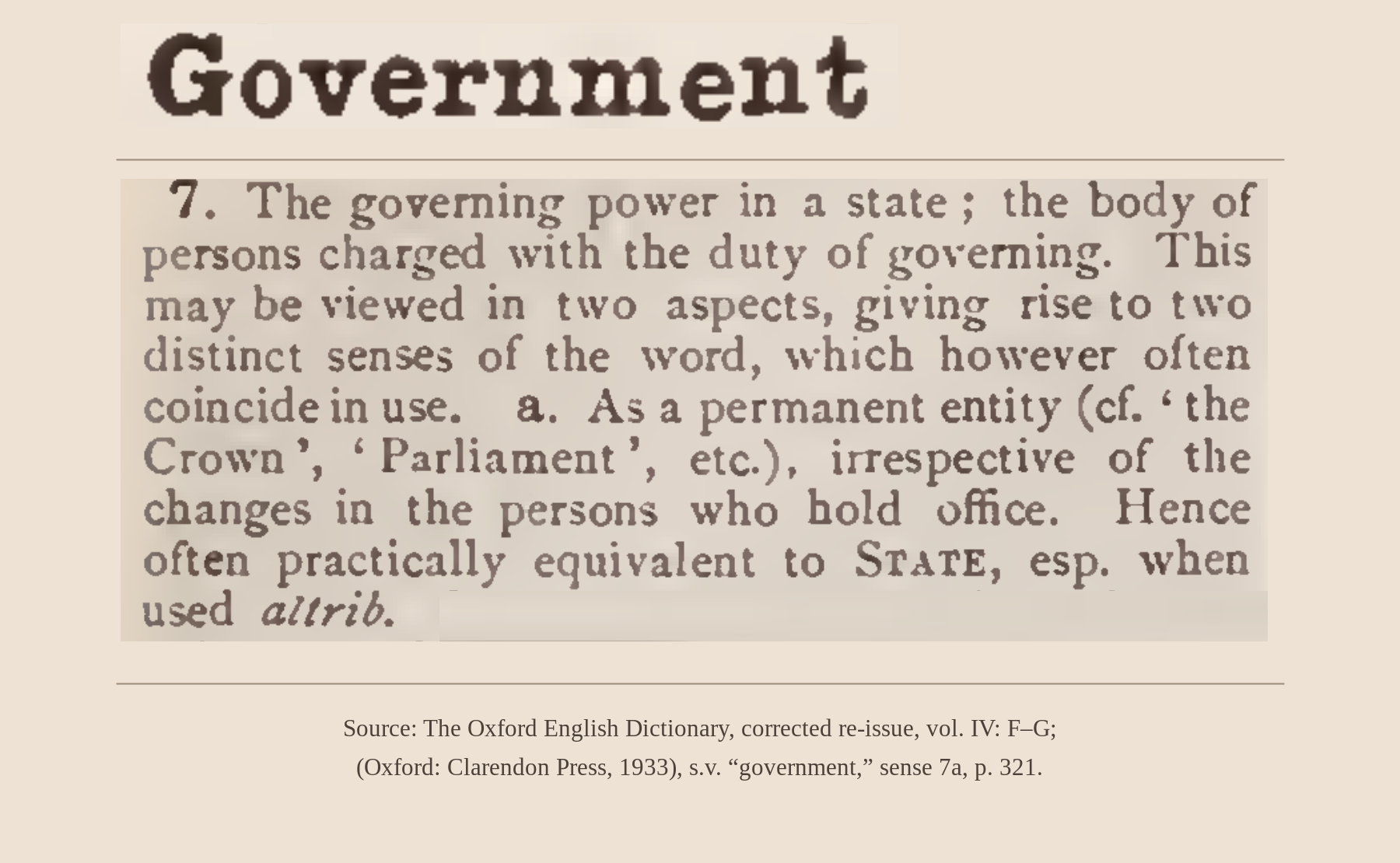
see the OED definition of state, n. 29.a a body politic;
fiction verses reality
office
in ministerial writing, man kind use office for an attributed duty, function, position, or capacity; it is neither the physical room nor the man and does no deed;
ministerial titles
in ministerial writing, man kind may use “government” as one collective name for a group; a man within that group may accept, assume, use, or officially represent a character-name such as minister or Secretary of State; the character is not the man and does no deed;
governing
a man directs, decides, administers, writes, or enforces; each deed belongs to the man who did it;
office word source; office has several senses; its Latin source includes service, duty, function, business, place, and appointment, with -ficium denoting doing; the OED separately labels sense 4c “Personified, or denoting an office-holder or office-holders as a body”, and separately records the physical place or room; the room is physical; the ministerial use is a word for an attributed duty, function, position, or capacity; it is neither room nor man and does no deed;
the Crown
see Crown;
Crown: official capacity
in X v Lord Advocate [2025] UKSC 44, paragraphs 37–45, Lord Reed and Lord Burrows used the word Crown, in the Crown Proceedings Act 1947 context, for the Sovereign in official capacity; in paragraph 40, they described the Crown in that capacity as a corporation sole, a legal entity with perpetual succession; they distinguished ministers and departments from the Crown, and applied the word Crown to official capacities beyond the expression His Majesty’s Government;
artificial continuity does not exist
man kind pretends the official capacity, continuing name, legal personality, attribution, and makes a paper record; a man accepts a role and uses a ministerial title; a man decides, writes, signs, or carries out the deed;
deeds attributed upon paper
- a deed attributed to Crown or Sovereign in official capacity;
- a deed attributed to a named ministerial title;
- a deed attributed to a department or agency name;
- a deed attributed to “government”;
observable cause
- a man accepts appointment and uses a role-name;
- man kind makes a paper record;
- a man decides, writes, signs, serves, or enforces;
- the deed remains the deed of man;
a man attaches attributes to the word Government; where the wording makes a name authorise, decide, own, command, continue, or do a deed, the device is prosopopoeia; there is no natural causal chain;
the invention of the Secretary of State, a corporation sole
an office in its ministerial sense is a position or function attributed by man kind, however it does not exist; this legal case shows the nonsense — OED, nonsense, n., sense 2: “Absurdity, nonsensicalness.” — used to pretend to bring a Corporation sole in to existance:
R (Global Feedback Ltd) v Secretary of State for Environment, Food and Rural Affairs [2023] EWCA Civ 1549, paragraphs 59–64;
official judgment — exact excerpts from paragraph 60 “the Secretary of State was the king’s private secretary with the custody of the king’s signet” the persons that comprise the Secretary of State “were all appointed by mere delivery to them of the seals of office” R (Global Feedback Ltd) [2023] EWCA Civ 1549, paragraph 60;
Act — exact words from Schedule 1 “Secretary of State” means one of Her Majesty’s Principal Secretaries of State. Interpretation Act 1978, section 5 and Schedule 1;
Cabinet Manual — exact excerpts quoted in paragraph 64 “there is only one office of Secretary of State” “even though it is the well-established practice to appoint more than one person to carry out the functions of the office” The Cabinet Manual, paragraph 3.26, quoted in paragraph 64;
in paragraphs 3.3–3.4 and 3.19 of the Cabinet Manual, the writers recorded a Prime Minister’s recommendation and attributed delivery of the seals by the Sovereign;
- the Prime Minister recommends a minster for the office of Secretary of State;
- a signet is then delivered, which confirms the appointment of the Secretary of State;
- more than one man pretends to be the “Secretary of State”
- the only things that are real in the sequence are the signet, and the man; all the rest is pretend;
the only things that are real in the above sequence are the signet, and the man; all the rest is pretend;
summary
in paragraphs 3.26–3.28 of the Cabinet Manual, the writers recorded the doctrine that there is one “office of Secretary of State”, although more than one man is appointed to carry out functions attributed to it; they also wrote that most secretaries of state are incorporated as corporations sole, that this gives a minister separate legal personality, and that it facilitates continuity when a different man is appointed;
continuity on paper but no new body
by writing that a man under a named character “shall be … a corporation sole”, man kind insert an artificial legal person into the attribution chain; this breaks any claim that man kind recorded a chain of natural bodies upon paper; cause never leaves the man; a man uses that character-name, relies upon the paper, and does the deed;
“The person who at the coming into operation of this Order is Secretary of State for Transport and his successors shall be, by that name, a corporation sole, with a corporate seal.” Secretary of State for Transport Order 1976, article 4(1);
application; in the source words above, Secretary of State for Transport is a fictional character; the words his successors repeat that character for each later man to whom man kind assign it; when a man accepts and uses that character, there is personation; shall be … a corporation sole attributes one continuing artificial legal person; no second body is made;
in section 2(1)(a) of the Ministers of the Crown Act 1975, man kind wrote that provision incorporating a Secretary of State as a corporation sole could be made by Order in Council; by those general words alone, man kind did not incorporate every Secretary of State; in section 3, man kind wrote what is to follow where man kind have written in an enactment that a named Secretary of State and his successors shall be a corporation sole; in article 3 of the Secretary of State for Justice Order 2007, man kind wrote that the Secretary of State for Justice and successors under that name shall be a corporation sole;
fiction and attribution audit
- Crown
- a name for an attributed official capacity; in the above Supreme Court judgment, the judges described Crown as a legal entity with perpetual succession and a corporation sole; the legal entity is artificial; where it is written: the Crown authorises, owns, commands, or acts, the wording is prosopopoeia, which is a falsehood; see mask;
- government
- a collective description for a group of man kind is not one natural body and not one corporation named Government; where people claim the Government did this or that, that feigned deed is prosopopoeia, which is a falsehood; see mask;
- ministerial “office”
- it is an abstract office to which man kind attaches duties, not a physical room and not a man; when a man represents the office, it is personation; where the office is presented as if it is real and can do things, that misdecription is prosopopoeia, which is a falsehood; see mask;
- Secretary of State
- it is a title held by Cabinet Ministers; man kind attribute corporation sole status to that person, and when used is personation; where the Secretary of State is presented as if it is real and can do things, that misdecription is prosopopoeia, which is a falsehood; see mask;
- department
- in paragraph 3.49 of the Cabinet Manual, it is written that the departments have no separate legal personality but attribute powers generally to the Secretary; where the department is presented as if it is real and can do things, that misdecription is prosopopoeia, which is a falsehood; see mask;
- man
- a man can: think, decide, write, speak, sign, touch, take, withhold, serve, or force; it is a man that invented the imaginary fictions above
boundary; in every interaction there is a man at each end of the chain; where a man pretends that a character shall be a corporation sole, he inserts an artificial legal person into the chain, at which point it becomes nonsense; a man can not interact in any way with fiction, as it does not exist; liability never leaves the man; the invented mask: corporation sole is a falsehood and can lead to deceit, and even fraud;
dominion
Edmund’s argument — exact words about “the people” “Before we ascribe sovereignty to the people we have to imagine that there is such a thing, something we personify as though it were a single body, capable of thinking, of acting, of making decisions and carrying them out” Edmund S. Morgan, Inventing the People: The Rise of Popular Sovereignty in England and America, p. 153;
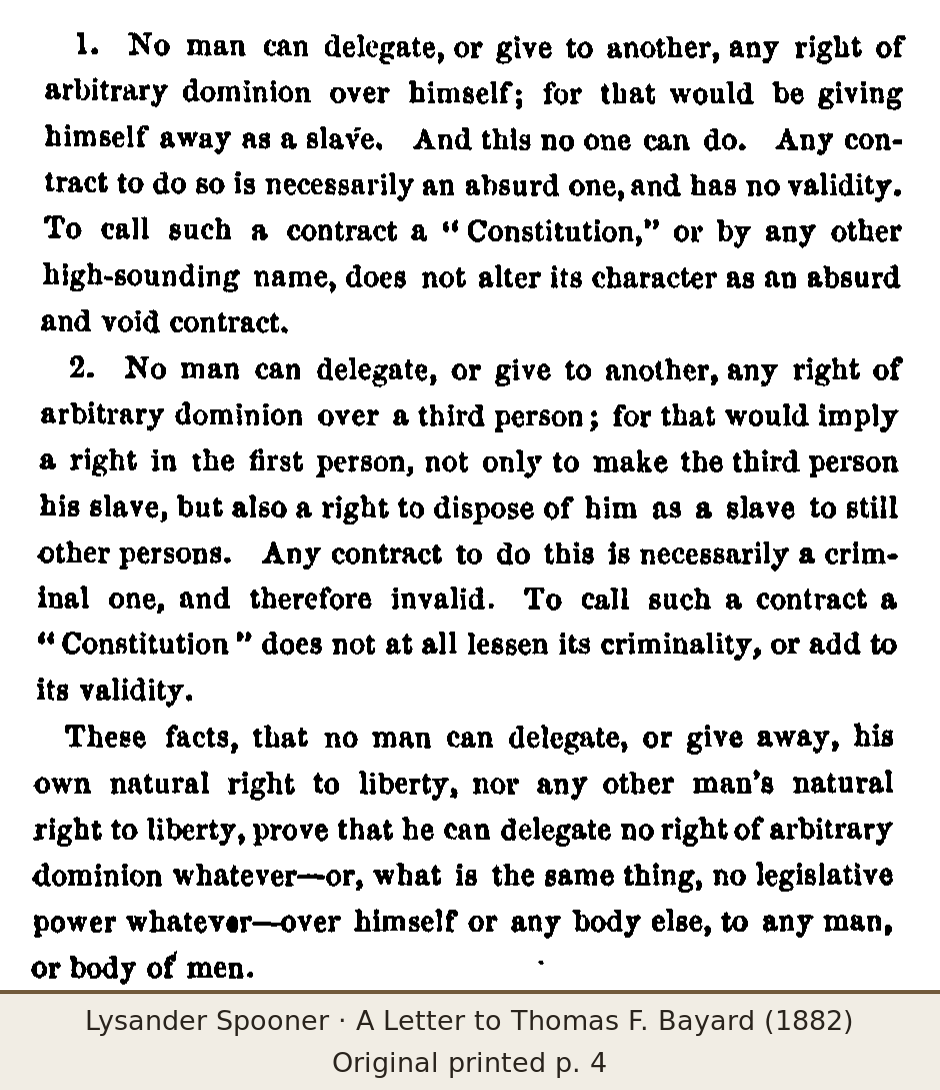
read the Bayard text transcript
“1. No man can delegate, or give to another, any right of arbitrary dominion over himself; for that would be giving himself away as a slave. And this no one can do. Any contract to do so is necessarily an absurd one, and has no validity. To call such a contract a ‘Constitution,’ or by any other high-sounding name, does not alter its character as an absurd and void contract.
2. No man can delegate, or give to another, any right of arbitrary dominion over a third person; for that would imply a right in the first person, not only to make the third person his slave, but also a right to dispose of him as a slave to still other persons. Any contract to do this is necessarily a criminal one, and therefore invalid. To call such a contract a ‘Constitution’ does not at all lessen its criminality, or add to its validity.
These facts, that no man can delegate, or give away, his own natural right to liberty, nor any other man’s natural right to liberty, prove that he can delegate no right of arbitrary dominion whatever—or, what is the same thing, no legislative power whatever—over himself or any body else, to any man, or body of men.”
conclusion
government is a title which man kind uses to claim authority
Government is a word used by those of man kind who wish to claim authority over, and exert power upon others of man kind, whether or not every man wishes to participate;
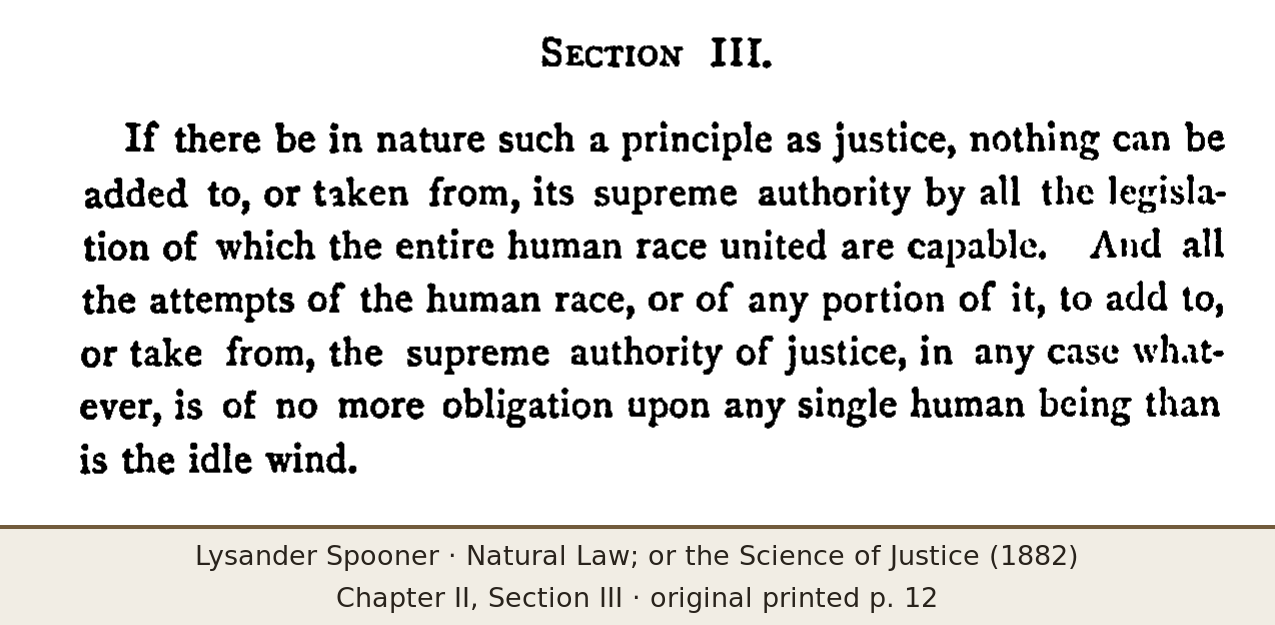
under Spooner’s natural-rights argument, a man does not obtain arbitrary dominion merely because a man marked a ballot, man kind counted it, a man accepted a ministerial title, or man kind use the collective term Government;
by inventing a "Corporation sole", man kind attribute artificial personality and continuity of office only on paper; when a man uses the word Government to claim authority, his claim is false;
authortiy can never come from fiction as it does not exist;
source boundary
- in the official sources, man kind wrote the legal and constitutional descriptions reported on this page;
- the Spooner facsimiles preserve his historical natural-rights arguments and their original printed page numbers;
- the conclusion drawn here is that writing or using an artificial-person name neither records the affected man’s agreement nor gives dominion to another man; cause remains with the man who does the deed;
- the linked flags mark the application at the relevant passage: falsehood marks what a man speaks, writes, presents, or maintains that does not accord with fact or what is true; fiction marks a feigned person or an artificial person or body-name presented as another doer; personation marks a character which a man accepts, assumes, uses, or officially represents; assignment of a title alone does not prove personation; prosopopoeia marks wording that presents an imaginary, absent, abstract, or artificial thing as a doer;
- abstraction, artificial legal personality, collective description, personation, and prosopopoeia are related distinctions but are not automatically the same device or deed; no flag alone proves knowledge, purpose, deceit, fraud, unlawfulness, or personal legal liability;
sources
- X v Lord Advocate [2025] UKSC 44, particularly paragraphs 37–45;
- R (Global Feedback Ltd) v Secretary of State for Environment, Food and Rural Affairs [2023] EWCA Civ 1549, particularly paragraphs 59–64;
- The Cabinet Manual, particularly paragraphs 3.3–3.4, 3.19, 3.24–3.28, and 3.48–3.50;
- Ministers of the Crown Act 1975, section 2, and section 3;
- Secretary of State for Transport Order 1976, article 4;
- Secretary of State for Justice Order 2007, article 3;
- House of Commons Library, Commanding confidence: Government formation in the UK;
- Oxford English Dictionary, second edition, government, n., senses 1, 6, and 7; office, n., etymology and senses 2, 4, 4c, and 8;
- Lysander Spooner, No Treason. No. VI. The Constitution of No Authority (1870), section III, p. 15;
- Lysander Spooner, A Letter to Thomas F. Bayard (1882), p. 4;
- Lysander Spooner, Natural Law; or the Science of Justice (1882), chapter II, section III, p. 12;
Edmund S. Morgan
“The success of government thus requires the acceptance of fictions, requires the willing suspension of disbelief, requires us to believe that the emperor is clothed even though we can see that he is not.”page 13;
“In order to be viable, in order to serve its purpose, whatever that purpose may be, a fiction must bear some resemblance to fact. If it strays too far from fact, the willing suspension of disbelief collapses.”page 13;
“Because it is a little uncomfortable to acknowledge that we rely so heavily on fictions, we generally call them by some more exalted name. We may proclaim them as self-evident truths, and that designation is not inappropriate, for it implies our commitment to them and at the same time protects them from challenge.”page 13;