the Crown is deemed to be a Corporation Sole, an artificial person with “legal immortality”, an idea for an immortal owner devised 450 years ago; but there is no way to transfer anything to or from an imaginary device, and the mechanism is no more than deception; every physical deed of transfer or licensing is performed by man kind;
- the writing, the copyright and the licence; a man writes an Act; copyright is attributed to an artificial person with “legal immortality”; man kind administer licensing in the Crown’s name;
- the parliamentary structure; man kind participate through continuing royal and episcopal offices, peerages and elected membership; Blackstone describes King and the three estates together as a body politic, an artificial person;
- the disputed claim to compel; historical writers disagree about the agreement or other grounds by which one or more of man kind may impose their will upon others;
1. the writing, the copyright and the licence
Man kind devise, write and publish the words of an Act of Parliament; in section 164(1) of the Copyright, Designs and Patents Act 1988, man kind wrote that “Her Majesty is entitled to copyright in every Act of Parliament”; in subsection (3), they include that entitlement within the description Crown copyright; copyright source detail;
Blackstone describes corporations as artificial persons with a kind of “legal immortality”, and includes the King among corporations sole; the continuity he describes is succession through the office; in X v The Lord Advocate [2025] UKSC 44, paragraphs 40–41, the judges discuss that continuing royal office and the Sovereign’s official capacity; Blackstone; the judgment;
licensing in the Crown’s name
In the published licensing arrangements, the Keeper of Public Records manages Crown copyright under Letters Patent; the usual terms for reuse are those of the Open Government Licence; its writers describe the Keeper as authorised to license information subject to Crown copyright and Crown database rights; licensing source detail;
The arrangement examined here begins with words written by man kind, proceeds through copyright attributed to the royal capacity, and returns to man kind administering permission to reuse those words; the page’s argument is:
if fiction is part of a chain, the end point is fiction;
fiction can not mix with reality, the two can never meet;
2. the parliamentary structure and body politic
Blackstone writes that the three estates are the Lords Spiritual, Lords Temporal and Commons; he describes the King in royal political capacity together with those estates as the “great corporation or body politic of the kingdom”; Book I, chapter 2, page 149;
Within that arrangement, man kind occupy the offices, attend, speak and vote; the following table shows the particular descriptions recorded in the sources;
| man acting or representing | artificial person / constituted capacity | evidence |
|---|---|---|
| The man holding the royal office | King/Crown in official capacity: corporation sole; personification of constitutional powers; | In X v Lord Advocate [2025] UKSC 44, paragraphs 40–45, the judges explain corporate continuity, official capacity, personification and the connection to the enacting formula; judgment; source detail; |
| A bishop participating as a Lord Spiritual | Episcopal office: corporation sole; | Blackstone writes that bishops are corporations sole and explains succession through the office; Book I, chapter 18, pp.457–458; source detail; |
| A man participating as a Lord Temporal | Peerage, parliamentary rank and membership; | The writers of Erskine May describe admission through the presentation of letters patent and writ of summons, oath or affirmation, and signing the Test Roll; paragraph 25.25; source detail; |
| A man elected and returned as an MP | Representative parliamentary capacity; participation in the Commons assembled; | Blackstone explains election through districts and service for the whole realm; the writers of Erskine May describe individual speech and voting within collective proceedings; Blackstone I.2, pp.154–155; Erskine May 13.12; source detail; |
| Man kind participating as King, Lords Spiritual, Lords Temporal and Commons together | The composite body politic; | Blackstone describes King and the three estates together as the “great corporation or body politic of the kingdom”; Book I, chapter 2, p.149; source detail; |
advice and consent
In the ordinary enacting formula, man kind write:
“by and with the advice and consent of the Lords Spiritual and Temporal, and Commons, in this present Parliament assembled”
The editors of Erskine May record that formula and its variants; the words name the assembled parliamentary capacities through which the participants give advice and consent; the wording and variants;
the devised arrangement
The corporate continuity described by Blackstone concerns successive holders of an office; his parliamentary account also includes peerage, election, representation and collective decisions; man kind devise and maintain these arrangements; art is used here in its sense of contrivance; OED source detail;
3. agreement and the claimed right to compel
The question is the ground upon which one or more of man kind claim a rightful power to impose their will upon another; the historical record contains competing accounts of consent, representation, public necessity and natural rights;
consent attributed through representation
In De Republica Anglorum (1583), Thomas Smith writes that parliamentary consent is taken as each man’s consent; Blackstone later describes every man in England as participating in the making of an Act through representatives, in the contemplation of law; both writers explain the attribution through representation; the passages and their context;
the historical disagreement
John Locke grounds the formation of a political community in individual consent, followed by decision through the majority; David Hume challenges the inference of consent from remaining in a country and grounds allegiance in public necessity; Lysander Spooner argues from each man’s inalienable liberty and condemns the claimed delegation of arbitrary dominion; each writer offers a different account of the grounds for political power; Locke, Hume and Spooner;
In the Commons on 18 May 1843, Sharman Crawford cited Smith’s attributed-consent account and Blackstone’s parliamentary structure, then challenged the adequacy of representation under the existing franchise; his speech places the dispute within the parliamentary record; Hansard source detail;
compulsory power and the deed
In the debate on the Police and Criminal Evidence Bill on 14 May 1984, Douglas Hurd defended the use of reasonable force, where necessary, in exercising compulsory powers; Gerald Bermingham argued for narrower limits; they discussed fingerprinting, entry and searches; the debate on reasonable force;
The decisions and the forcement are deeds of man kind; the OED definition of forcement, sense 3, is “Compulsion; also, a compelling motive.”; the OED entry;
The argument pursued here asks the man claiming authority to state the particular deed he proposes, name the man affected, and set out the agreement or other ground he offers as justification; where he relies on Crown, office or parliamentary consent, the enquiry follows that claim back to the decisions and deeds of man kind;
references and source detail
Erskine May: author, publication and parliamentary use
Thomas Erskine May published the first edition of A Treatise on the Law, Privileges, Proceedings and Usage of Parliament in 1844; he was then an assistant in the House of Commons library and later became Clerk of the House; he prepared nine editions, and later editors continued the work; publication history and use;
The editors describe parliamentary procedures, their development, and the constitutional conventions followed by participants in the Commons and Lords; Speakers cite the work in rulings, and members refer to it during debate; the online text is available through the Parliament website;
The twenty-fifth edition was published in 2019; its named editors are Sir David Natzler and Mark Hutton, supported by assistant editors with experience as parliamentary clerks; in his preface, Natzler explains the introduction of numbered paragraphs and the arrangements for online updates; editors; preface;
The references used above are paragraph 25.25 on the introduction of Lords Temporal, paragraph 13.12 on proceedings in Parliament, and paragraph 26.9 on the enacting formula; further detail appears in the dropdowns below;
return to the participating structure; return to advice and consent;
the enacting formula: advice, consent and the recorded variants
In Erskine May, paragraph 26.9, the editors describe the enacting formula as the paragraph placed before the clauses of a bill and date its development to the fifteenth century; in the ordinary wording they name the monarch, the Lords Spiritual and Temporal, and the Commons assembled in Parliament; the version reproduced there uses the title Queen; paragraph 26.9;
They also record additional financial wording for Supply and Appropriation and Finance Bills; in that wording the Commons' responsibility for granting money or duties is expressed;
For the procedure under the Parliament Acts 1911 and 1949, the writers specify an enacting formula naming the monarch and the Commons and expressly referring to those Acts; the prescribed words are recorded in section 4 of the Parliament Act 1911;
Examples can be read in the introductions to the Energy Act 2013, with the ordinary formula, and the Hunting Act 2004, with the Parliament Acts formula;
the royal office and corporation sole: the 2025 judgment
In X v The Lord Advocate [2025] UKSC 44, dated 10 December 2025, Lord Reed and Lord Burrows wrote the judgment, with Lord Hodge, Lord Briggs and Lady Simler agreeing; the legal question concerned vicarious liability for alleged wrongdoing by a Scottish judicial office-holder; judgment;
In paragraph 40 they describe corporation sole in terms of a single office-holder and perpetual succession; they connect this description with continuity of the royal office and distinguish the monarch's private and public capacities; their cited authorities include Sutton's Hospital (1611) and Attorney General v Köhler (1861);
In paragraph 41 they explain that, in some contexts, Crown means the Sovereign in official capacity; in paragraph 45 they discuss legislative and judicial functions, including the monarch's place in the enacting formula;
return to the opening; return to the participating structure;
Blackstone: the estates, body politic and corporations sole
In Book I, chapter 2, page 149, William Blackstone writes that the three estates are the Lords Spiritual, Lords Temporal and Commons; he describes the King in royal political capacity together with those estates as the body politic of the kingdom; his account is an eighteenth-century description of the parliamentary arrangement; chapter 2, Of the Parliament;
On page 151 he describes the constitutional parts as connected through an arrangement of mutual checks; on pages 154–155 he describes election through particular districts and the elected member's service for the whole realm;
In Book I, chapter 18, pages 455–456, Blackstone introduces artificial persons, bodies politic and corporations through the continuation of rights across successive holders, describing a kind of “legal immortality”; on page 457 he distinguishes corporations aggregate, comprising several members, from corporations sole, comprising one holder and successors in a particular station; chapter 18, Of Corporations;
His examples of corporations sole include the King, a bishop, a parson and a vicar; on page 458 he explains succession to parsonage rights and continuity of the royal office;
return to the participating structure; return to the connection to art;
Lords Temporal: life peerage, letters patent and admission
In section 1 of the Life Peerages Act 1958, man kind wrote of conferring a peerage for life by letters patent; in subsection (2), the specified incidents include the rank of baron under the style appointed in the letters patent and, subject to the stated qualification, receipt of writs of summons and participation by sitting and voting in the House of Lords; the peerage expires on the holder's death; section 1;
In Erskine May, paragraph 25.25, the editors describe introduction between two supporting members; at the Table, the herald hands the letters patent to the Reading Clerk, and the new member hands over the writ of summons;
The Reading Clerk reads the letters patent and administers the oath or affirmation; the new member signs the Test Roll and an undertaking to abide by the Code of Conduct, then proceeds to the Woolsack to shake hands with the Lord Speaker; paragraph 25.25;
Commons and MPs: representation and participation in proceedings
Blackstone describes members elected through particular districts and returned to Parliament, with service for the whole realm; this account appears in Book I, chapter 2, pages 154–155; Blackstone's account of representation;
In Erskine May, paragraph 13.12, the editors explain the parliamentary use of proceedings in terms of formal collective business and decisions; they describe individual participation through speech, voting, giving notice of a motion, and presenting a petition or a committee report; paragraph 13.12;
In the same passage they describe parliamentary officers carrying out orders and members of the public participating by giving evidence or securing presentation of a petition; the paragraph's references include parliamentary journals, committee reports and judgments concerning parliamentary privilege;
Crown copyright and the Open Government Licence
In section 164(1) of the Copyright, Designs and Patents Act 1988, man kind wrote of Her Majesty's entitlement to copyright in every Act of Parliament; in subsection (2)(a), the stated period runs to the end of fifty years from the end of the calendar year of Royal Assent; in subsection (3), they include copyright under this section within the references to Crown copyright in Part I, subject to the stated exception for section 163; section 164;
In version 3.0 of the Open Government Licence, the writers set out permission to copy, publish, distribute, transmit, adapt and use the covered information commercially and non-commercially, subject to the stated terms; users must acknowledge the source and include or link to the specified attribution, with a licence link where possible; Open Government Licence v3.0;
In the licence's definitions and accompanying explanation, the writers describe the Keeper of Public Records as authorised to license information subject to Crown copyright and Crown database rights; in the published Crown copyright guidance, they describe management by the Keeper under Letters Patent and give the Open Government Licence as the default for most covered information;
the Annex A image
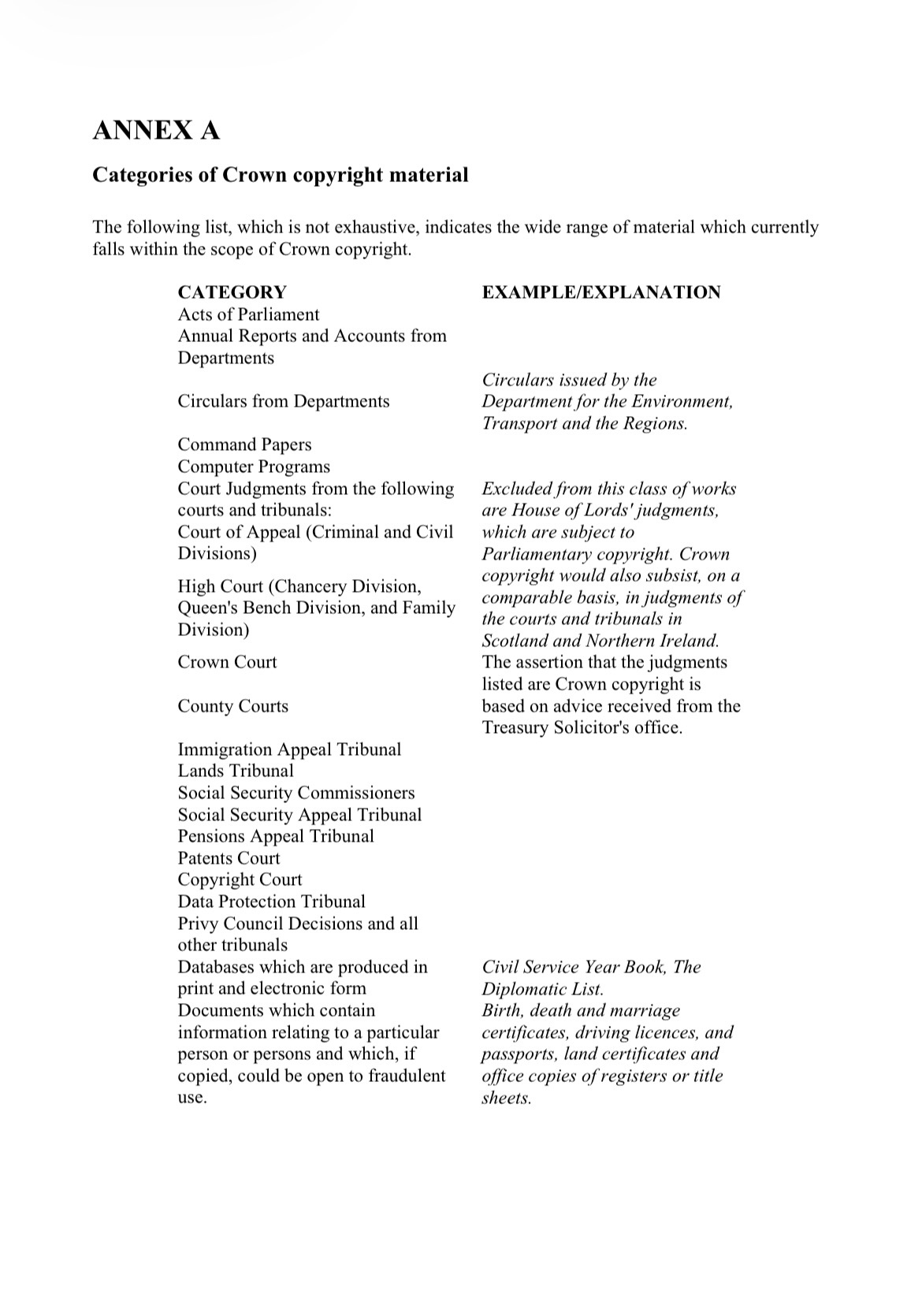
The reproduced Annex A list includes Acts of Parliament among Crown copyright material; the image and its source context are also recorded on the Crown page;
the OED entries: art and forcement
Under art, noun, sense 14, the readable OED transcription is: “An artifice, contrivance, stratagem, wile, trick, cunning device. Chiefly in pl.”; the corresponding 1933 printed entry is in volume I, page 468, with the headword and etymology on page 467; art: transcription and facsimile;
Under forcement, noun, sense 3, the definition is: “Compulsion; also, a compelling motive.”; the 1933 entry is in volume IV, page 422; the dagger marks this sense as obsolete, and the illustrative quotation is dated 1524; forcement: transcription and facsimile;
The readable entries on the linked OED page follow the electronic OED2 transcription; each entry has separate image crops for the headword and the printed sense, together with its bibliographical reference;
Smith and Blackstone: consent attributed through representation
In Book II, chapter 1 of De Republica Anglorum, published in 1583, Thomas Smith describes each Englishman as present in Parliament personally or through representatives; he then writes: “And the consent of the Parliament is taken to be everie mans consent.”; the spelling follows the linked transcription; Smith, Book II, chapter 1;
In Book I, chapter 2, page 178 of the Commentaries, Blackstone explains legal participation in making an Act through representatives; he places this explanation in his discussion of promulgation and the authority attached to legislation after enactment; Blackstone, page 178;
These are the writers’ recorded explanations of representative consent; Smith describes what is taken as each man’s consent, and Blackstone writes of the legal contemplation through which participation is attributed;
Locke, Hume and Spooner: consent, necessity and natural rights
In the Second Treatise of Government, sections 95–97, John Locke begins with individual agreement to unite into a political community; he then explains majority decision within the resulting body politic; in sections 119–122 he discusses express and tacit consent, including residence and enjoyment of property or protection; Locke, chapter VIII;
In Of the Original Contract, paragraphs 23–24, David Hume questions the claim of free consent inferred from remaining in a country; he uses the example of a poor worker facing the practical difficulty of emigration; in paragraphs 35–38 he grounds allegiance in the interests and necessities of society and discusses the question of whom allegiance is due to; Hume’s essay;
In A Letter to Thomas F. Bayard (1882), Lysander Spooner addresses Bayard’s description of public power as a delegated trust; in his opening argument and numbered reasons 1–2, he treats liberty as inalienable and describes the supposed delegation of arbitrary dominion over oneself or another as invalid; he also challenges proof of delegation through secret voting; Spooner’s letter;
Locke discusses the formation and powers of political society; Hume examines the ground of allegiance; Spooner challenges the authority claimed by American legislators; these are the arguments made by the named writers in the cited works;
Hansard: representation in 1843 and compulsory powers in 1984
On 18 May 1843, Sharman Crawford sought leave to introduce a bill concerning fuller representation and shorter Parliaments; in his speech he quoted Thomas Smith on parliamentary consent and Blackstone on the King and estates; he then questioned how adequately the existing Commons represented the population under the franchise of that time; the proposed leave was rejected, with 32 voting for and 101 against; Hansard, Parliamentary Reform, 18 May 1843;
On 14 May 1984, during consideration of the Police and Criminal Evidence Bill, Douglas Hurd moved a clause concerning reasonable force in the exercise of police powers; he gave examples involving compulsory fingerprinting, entry under a search warrant and searches of arrested suspects;
Gerald Bermingham supported a narrower amendment and argued for strict limits; Robert Maclennan also criticised the breadth of the proposal; the amendment was rejected and the new clause was added to the bill; Hansard, Power of Constable to Use Reasonable Force, 14 May 1984;
return to the historical disagreement; return to compulsory power;