when a man attributes a deed to a role, office, corporate body, or other mask, he presents the mask as though it did the deed, however, liability never leaves the man, because the mask is fiction
feign a person to mask the man
the feigning of person
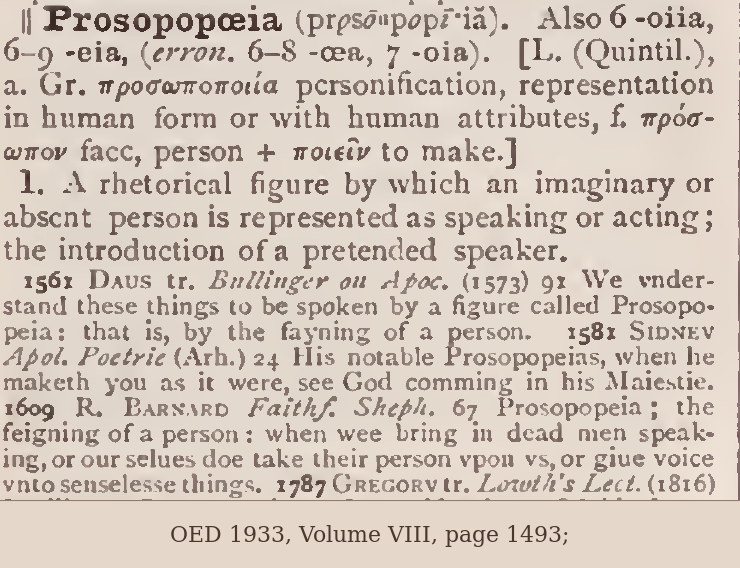
a 1609 OED quotation calls prosopopoeia “the feigning of a person”;
“our selues doe take their person vpon vs, or giue voice vnto senselesse things”;
1609 quotation under prosopopoeia; source image in the evidence below;
personation: a character assumed by a man; prosopopoeia: an imaginary or absent person, or a thing, presented as doing a deed; personification: the later gloss;
statements and attribution
statements classified as personating or prosopopoeia
falsehoods
feigning of person
“I am a constable.”
personating; constable is a role, a mask, a fiction;
“The Police force detained you.”
prosopopoeia; 'Police force' is presented as though it did the deed; Police force is fiction
“The Chief Constable authorised me.”
prosopopoeia; Chief Constable is defined as a corporation sole, a fiction; a fiction can not authorise;
“My warrant card gives me authority.”
prosopopoeia; the card is presented as though it gives authority;
“HMCTS requires attendance / HMRC says £1,000 is owed.”
prosopopoeia; the masks HMCTS and HMRC are presented as though they require or speak;
“The Court ordered / decided.”
prosopopoeia; the mask, Court, is presented as though it ordered or decided;
“A man is prosecuted by the Police force.”
prosopopoeia; 'Police force' is presented as though it prosecuted; the mask: 'Police force' hides the deeds of man kind;
falsehood, deceit and fraud
the use of prosopopoeia or personating to mask a role, legal person, company, corporation, corporation sole, or office as a separately existing person is falsehood;
falsehood;
the feigned person, a fiction, is presented as fact, and a deed is falsely attributed to the fiction, not the man;
deceit;
the man knowingly uses that false appearance to mislead another man;
fraud;
the man uses that deceit for unjust gain or advantage, such as payment, compliance, attendance, surrender, process, control;
where man kind use artificial persons as masks for their deeds in society or government to obtain compliance or control, the falsehood is the means, deceit is its knowing use, and fraud is the deed;
conclusion
by personation, a man pretends he is the mask;by prosopopoeia, he gives voice to the feigned person or attributes a deed to it;the feigned person is his mask; the man does the deed; liability never leaves the man;
evidence
source images and records;
OED word evidence
OED 1933, Volume VIII, page 1493; the 1609 source for “the feigning of a person”;
the images contain the headwords, selected senses, dates, and spelling; the definitions below are short working summaries, not replacements for the complete entries;
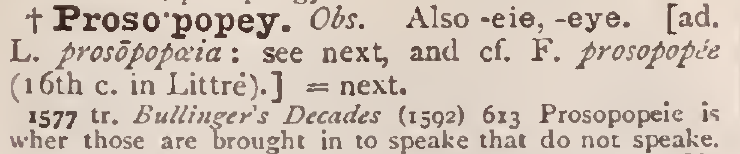
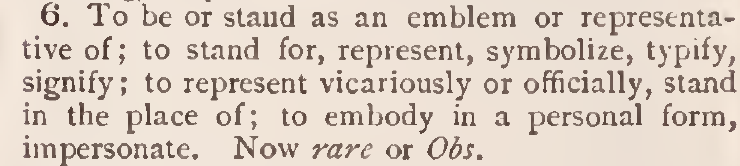
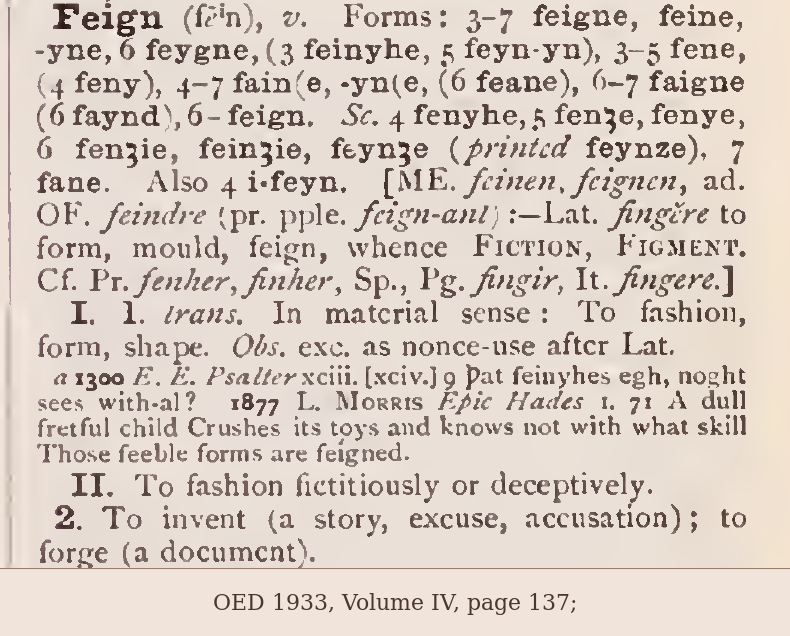
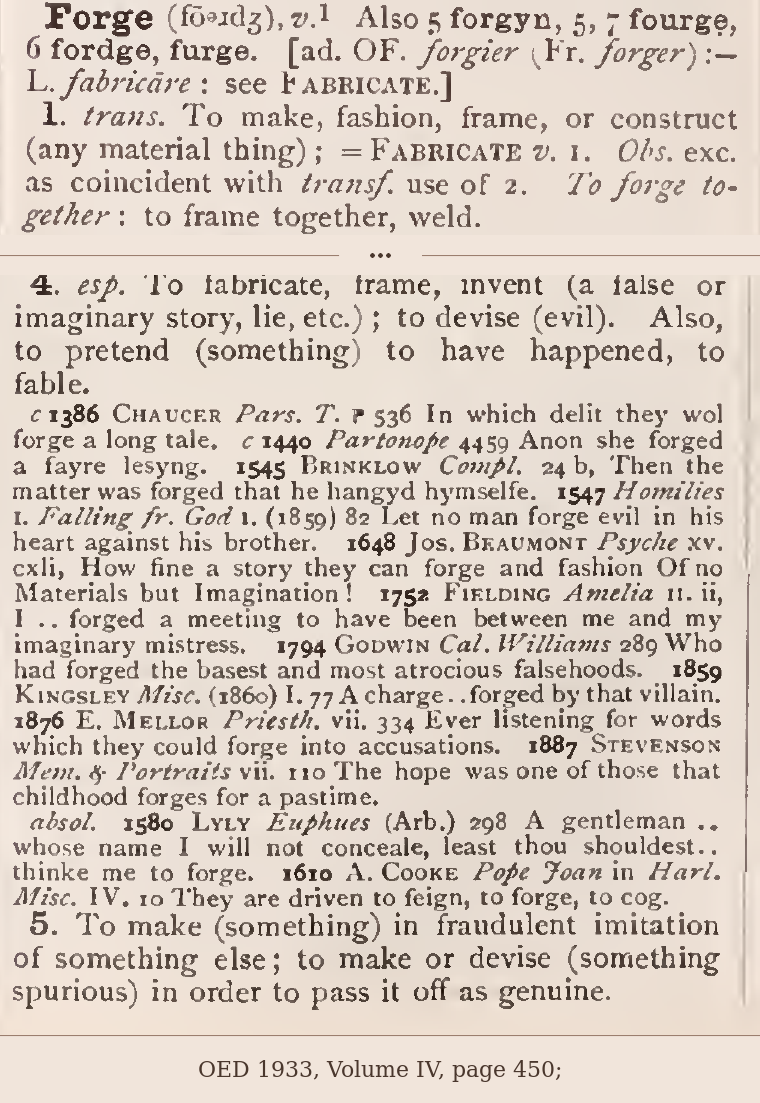
OED 1933, Volume VIII, page 1493; obsolete English prosopopey and the 1577 quotation;OED 1933, Volume VII, page 728; personate, selected sense;OED 1933, Volume IV, page 137; feign, selected source record;OED 1933, Volume IV, page 450; selected forge senses are joined by an ellipsis;
official source evidence
these sources record the institutional words and arrangements used in the examples; they do not replace the factual question: which man spoke, wrote, decided, demanded, touched, stopped, bound, or took?
Police force and constable
Police Act 1996, section 2 records that a Police force shall be maintained for every police area listed in Schedule 1;
section 29 contains attestation as a constable by making the declaration in Schedule 4; its words include causing the peace to be kept and preserved, and preventing offences against people and property;
on the official HMCTS page, man kind have written of Court and tribunal administration, work with an independent judiciary, and staff employed by HMCTS;
prosopopoeia; HMCTS is presented as though it required attendance;
HMRC and Court
on the official HMRC page, man kind describe the department, the Commissioners for Revenue and Customs Act 2005, and commissioners appointed by the King;
prosopopoeia; HMRC is presented as though it spoke; Court is presented as though it ordered or decided;
man kind may use statutory wording to attribute a function, decision, power, or deed to a name; this page returns the observable deed to the man without pretending that every named structure has the same recorded form;
word families and working sequence
these form overlapping word families rather than one strict etymological chain;
word families and short meanings
word
short meaning
personate
to play or assume a character; to pass oneself off as another person; in OED sense 6, now rare or obsolete, to represent vicariously or officially; in rare sense 7, to represent a thing as a person; state the sense used;
personating
the action expressed by personate; on this page, the deed of the man who personates;
personation
the action of personating; recorded senses include assuming or passing oneself off as another person, dramatic representation, and embodiment; the word alone does not prove deceit;
personify
to represent a thing or abstraction as a person, or attribute personal characteristics to it;
personification
the attribution of personal form, nature, or characteristics, or representation of a thing or abstraction as a person; the later English gloss for the second sense of prosopopoeia, not a separate stage;
prosopopey
obsolete English form of prosopopoeia;
prosopopoeia
a rhetorical figure by which an imaginary or absent person is represented as speaking or acting; also one by which an inanimate or abstract thing is represented as a person or with personal characteristics;
feign
from Middle English through Old French feindre and Latin fingere, “form, mould, feign”; senses include fashion or form, invent, represent in fiction, imagine, disguise, and pretend; no compulsory sequence runs through the senses;
feigning
the action of feign; in a rare sub-sense the OED records “feigning of person: personification”;
fayning / feyning
historical spellings of feigning; the cited 1561 quotation has fayning and the 1609 quotation has feigning;
feigned person
working description for the name, role, office, or thing presented as though it spoke or did the deed; no person or being is produced;
fiction
in OED sense 3b, something imaginatively invented: a feigned existence, event, or state; invention opposed to fact; sense 3a allows invention for deception or otherwise;
figment
something moulded or fashioned, an invented statement or story, or a notion framed in the mind, according to the selected sense;
forge / forging
in the relevant senses, to fabricate a false or imaginary account, or make something spurious to pass as genuine; a separate word family from feign, fiction, and figment;
falsehood
what is presented does not accord with fact or what is true;
deceit
PB working use: a man knowingly uses falsehood, false appearance, or a concealed fact to mislead another man;
the useful working sequence; select each word only where the words and deed establish it;
personation; where a man personates, his deed is personation;
prosopopoeia; where a man presents an imaginary or absent person as speaking or acting, or an inanimate or abstract thing as a person, the representation is prosopopoeia;
feigned person; the apparent person presented by the words is described here as the feigned person;
falsehood; where what is presented does not accord with fact or what is true, it is falsehood;
deceit; where a man knowingly uses the falsehood, false appearance, or concealed fact to mislead another man, his deed is deceit;
“forging a false person” is the stronger PB applied description where a man fabricates a false person-representation, or makes a spurious representation to pass as genuine; it is not an OED expression or a necessary stage; the older source expression for the basic device is “feigning of person”;
the false separate doer is falsehood; knowing use of that false appearance to mislead is deceit; use of the deceit for gain, advantage, payment, compliance, attendance, surrender, process, control, or loss is fraud;