the registration number is said to be owned by The Secretary of State for Transport, a Corporation Sole; licences are granted by the same; and the same registers a vehicle; the Corporation Sole is a 400 year old idea, faulty in its conception; no mechanism exists to pass things from reality to imagination;
in reality, a man pretends to represents artificial persons;
the owner written in the record
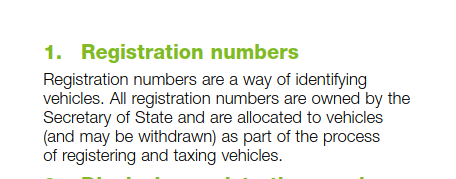
in section 23 of the Vehicle Excise and Registration Act 1994, man kind wrote of “the registration mark for the time being assigned to a vehicle”; Acts;
registration mark: assignment, withdrawal, and reassignment
source: section 23(1)in section 23(1) of the Vehicle Excise and Registration Act 1994, it is written that, where the Secretary of State registers a vehicle under section 21(1), “he shall assign to the vehicle a mark”; that registration mark indicates the registered number of the vehicle;
source: section 23(2)in subsection (2), man kind wrote that the Secretary of State may, in circumstances he determines, assign another mark to a vehicle, assign a mark previously assigned to another vehicle, withdraw a mark, and reassign a mark previously withdrawn from that vehicle;
- registration number or mark
- man kind attribute ownership to the continuing Secretary of State office
- the alleged owner is the corporate office, not man kind
- the corporate office is a corporation sole: an artificial person; fiction
driving licence: grant, issue, and deem
sourcein section 97(1) of the Road Traffic Act 1988, it is written that, subject to the provisions there named, “the Secretary of State must … grant a licence”; in subsection (1A), man kind wrote of that licence being in the form of a photocard; on its GOV.UK page, man kind using the DVLA name write that DVLA is responsible for “issuing photocard driving licences”;
deemingin article 4(1) of the Secretary of State for Transport Order 1976, man kind wrote that the office-holder and successors “shall be, by that name, a corporation sole”; in article 4(3), man kind wrote that a qualifying instrument purporting to be made or issued by the Secretary of State, and authenticated in the specified manner, is to be “deemed to be so made or issued without further proof”, unless the contrary is shown;
deem, v.
9. trans. To think of (something) as existent; to guess, suspect, surmise, imagine. Obs. Oxford English Dictionary, second edition;
applicationa woman or man pretends to be the Secretary of State for Transport; man kind attribute the grant of the licence to that continuing office-name and attribute issue of the photocard to the DVLA name; a fiction can not bring anything in to reality, it does not exist;
conclusion
the registration number and photocard are real things made and used by man kind; fiction neither owns the number nor grants or issues the licence; a fiction can not bring anything in to reality, it does not exist;
the registration number on a car is real; in INF46, man kind attribute ownership of it to the Secretary of State, an artificial continuing office which is an imaginary concept; a man using the Secretary of State or DVLA name makes and maintains the record, but that record does not demonstrate observable 'ownership' by the artificial office in reality; the fiction can not own the registration number on a car, no matter what paper is filled in; there is no way for the boundary to cross from reality to fiction, the two can never meet;
deceit is a wrong, and deceit for gain or advantage is fraud;
footnote for interest;
why corporation sole is fiction
“…shall be, by that name, a corporation sole, with a corporate seal.” Secretary of State for Transport Order 1976, article 4(1);
in article 4, man kind put the then office-holder and successors under one continuing corporate name; in paragraphs (2) to (4), man kind provided for man kind to authenticate, sign, or execute instruments; man kind supplied the name, succession, seal, and legal attribution; no man who owns was revealed;
“‘Secretary of State’ is a distinct legal concept, being a corporation sole.” Khan v Secretary of State for Foreign, Commonwealth and Development Affairs [2025] EWCA Civ 41, paragraph 138;
“artificial persons are created and devised by human laws for the purposes of society and government” William Blackstone, Commentaries on the Laws of England, Book I, chapter 18;
Blackstone, a man, called those artificial persons corporations or bodies politic; he recorded that man kind devise the construction; no man, by writing, makes that imaginary construction into a man or brings it into reality; it has no natural body, awareness, will, voice, or deed;
- bodynone;
- awarenessnone;
- will or voicenone;
- deednone;
the imaginary office can not speak, possess, or do, and fiction can not cross into reality;
where DVLA fits
“The DVLA is an executive agency of the Department for Transport and has no separate legal personality from that Department.” DVLA KADOE contract, clause A4.2;
in clause A1.1, man kind named the contracting party as the Secretary of State for Transport acting through DVLA; in clause A4.2, man kind wrote that DVLA has no separate legal personality from the Department; man kind use the DVLA name for the administrative structure and for man kind authorised within it;
| registration mark | the registration number which man kind record as assigned to a vehicle under the written statutory scheme; |
|---|---|
| 'owner' named in INF46 | Secretary of State: a distinct legal concept and corporation sole; |
| DVLA | executive agency-name; in the contract, man kind wrote that it has no separate legal personality; |
| Department for Transport | ministerial department-name; not man kind; |
| Secretary of State | office-name and distinct legal concept; in source writing, it is called a corporation sole; |
| corporation sole | artificial continuity device devised by man kind to treat successive office-holders under one name; |
| man | the man whose deeds are observable: he writes, signs, records, decides, sends, demands, withholds, receives, or uses the paper; |
the observable cause
- a man decides or does
- the man writes, signs, records, or sends
- the man uses an officer role and the DVLA name
- the man writes “DVLA decided” or “DVLA requires”
by writing that final sentence, the man hides the deeds he does and personates the imaginary agency-name as having done them; this is deception, and to do so for advantage or gain is fraud; man kind may attribute legal consequence to an office-name, but observable cause never leaves the man who did the deed; fiction can not cross into reality;
evidence ledger
below, man kind wrote how the names, functions, property, registration marks, and works are treated; man kind supplied no independent body, awareness, will, voice, or deed for DVLA or the alleged owner;
birthdays - driver, keeper
these are dates on which man kind wrote the descriptions into the motor-vehicle statutory scheme; first use, licensing, definition, and commencement are kept separate; arising as they do in Crown Acts of Parliament, registered keeper, and Driver are a Crown licensed products, and as such, can not exist in reality
- driver - 1 August 1861: first use verified herein section 6 of the Locomotive Act 1861, man kind wrote “Owner or Driver of any Locomotive”; the word is used there, not defined;
- driver - 14 August 1903; in operation 1 January 1904: licensingin section 3 of the Motor Car Act 1903, man kind wrote that a person shall not drive a motor car on a public highway unless licensed for that purpose; in section 20(2), man kind appointed 1 January 1904 for the Act to come into operation;
- driver - 1 August 1930: express definitionin section 121(1) of the Road Traffic Act 1930, man kind wrote that “Driver”, where a separate person acts as steersman, includes that person and any other person engaged in driving; this is the first express definition verified here in the motor-vehicle lineage;
- keeper relation - 4 August 1920; applied from 1 January 1921in section 13 of the Finance Act 1920, man kind wrote that vehicle duties were to be paid on licences taken out by “the person keeping the vehicle”; the keeping relation is written there, but the noun-label keeper is not;
- keeper - 25 June 1969: noun-labelin section 17 of the Vehicle and Driving Licences Act 1969, man kind wrote a substituted provision about a person who “becomes or ceases to be the keeper” of a mechanically propelled vehicle;
- registered keeper - 1 February 1970: substitution in operationin Schedule 2 paragraph 10 of the Vehicle and Driving Licences Act 1969, man kind substituted keeper for owner in the phrases then written in section 241(2)(c)(ii) and (4)(a) of the Road Traffic Act 1960; read together, “registered as the owner” and “registered owner” became “registered as the keeper” and “registered keeper”; in article 2 of the Commencement No. 4 Order, man kind appointed 1 February 1970 for that amendment to come into operation;
these milestones record when man kind first used, licensed, or defined each description within the motor-vehicle sources checked;
agency, department, office, and succession
from 1973, man kind used the Driver and Vehicle Licensing Centre name while registering and licensing drivers and new vehicles; from April 1990, man kind used the Driver and Vehicle Licensing Agency name for an executive agency of the Department of Transport; on GOV.UK, man kind list DfT as a ministerial department and DVLA as one of its executive agencies;
- 1975in section 2, man kind wrote words permitting man kind to make a Secretary of State a corporation sole by Order; in section 3, man kind wrote statutory continuity for deeds which man kind did in relation to the named office;
- 1976in article 4, man kind wrote the Secretary of State for Transport and successors, by that name, as a corporation sole with a corporate seal;
- 1997 and 2001in later Orders, man kind wrote successor combined portfolio-names as corporations sole and carried functions, property, rights, and liabilities through those names;
- 2002in the Order, man kind wrote the transfer of transport functions and connected property, rights, and liabilities to the Secretary of State for Transport and wrote statutory continuity;
man kind working under the DVLA name maintain records, issue or withhold licences and registration documents, assign or withdraw registration marks, receive notifications, and collect or enforce vehicle excise duty; man kind attribute each function to the names in writing, while each deed is done by a man;
registration marks and physical plates
in INF46, man kind wrote about ownership of the registration number, not the plate; in section 23 of the Vehicle Excise and Registration Act 1994, man kind used the language of a registration mark assigned to a vehicle; man kind thereby distinguished the statutory mark and entitlement from the physical plate and vehicle;
| physical plate | an acrylic or metal thing made and possessed by man kind; |
|---|---|
| registration mark | the registration number displayed upon the car and written in the record which man kind maintain; |
| vehicle | the physical thing, distinct from its mark, certificate, and registered-keeper description; |
the former trading fund and Crown assets
in 2004, man kind made the DVLA Trading Fund Order, established a fund for DVLA operations, and called the allocated assets and liabilities Crown assets and liabilities; man kind did not incorporate DVLA as another person or create DVLA shares;
in 2011, man kind made the Revocation Order and ended the fund from 1 April 2011; in the Department for Transport explanatory memorandum, man kind wrote that trading funds are not separate legal entities and that DVLA remained an executive agency;
Crown copyright, works, and Blackstone
“Where a work is made by Her Majesty or by an officer or servant of the Crown in the course of his duties…” Copyright, Designs and Patents Act 1988, section 163(1), original enacted wording;
in section 163, man kind wrote of a qualifying work; they did not write that the DVLA agency-name is a copyright work or corporation, nor that it lives or does a deed; a man makes the form, manual, guidance, software, photograph, diagram, publication, or arrangement; man kind then write that “Her Majesty” is first owner and call the copyright Crown copyright; man kind thereby attribute ownership to fiction after the man has done the deed; cause remains with the man;
William Blackstone, a man, wrote that artificial persons are “created and devised by human laws for the purposes of society and government” and called them corporations or bodies politic; those words are evidence that man kind devise the person, body, office, succession, and name, not proof that the device lives or does a deed;
related
sources
- Locomotive Act 1861, section 6; Motor Car Act 1903, section 3 and section 20; Road Traffic Act 1930, section 121;
- Finance Act 1920, section 13; Vehicle and Driving Licences Act 1969, section 17 and Schedule 2 paragraph 10; Road Traffic Act 1960, section 241 as enacted; Vehicle and Driving Licences Act 1969 (Commencement No. 4) Order 1969, article 2;
- DVLA, About us;
- DVLA KADOE fee-paying contract, clauses A1 and A4.2;
- Department for Transport, A review of DVLA, 2014;
- Department for Transport, GOV.UK organisation record;
- Secretary of State for Transport Order 1976, article 4;
- Ministers of the Crown Act 1975, section 2 and section 3;
- Secretary of State for the Environment, Transport and the Regions Order 1997;
- 2001 transport, local government, regions, environment and rural affairs Order;
- Transfer of Functions Order 2002;
- Khan v Secretary of State [2025] EWCA Civ 41, paragraph 138;
- DVLA Trading Fund Order 2004, article 5, Revocation Order 2011, and the Department for Transport explanatory memorandum;
- DVLA, INF46, Registration numbers and you;
- Vehicle Excise and Registration Act 1994, section 23;
- Road Traffic Act 1988, section 97;
- Copyright, Designs and Patents Act 1988, section 163;
- The National Archives, Crown copyright;
- William Blackstone, Commentaries on the Laws of England, Book I, chapter 18;