the argument
a man prepares, writes, signs, seals and issues the documents; the royal office, the authority and the appointment are represented in the words and the seal; there is no mechanism for a man to pass something to an imaginary person, no matter how fancy the process is;
the process starts from art; the claimed authority is attributed to the represented royal person, deemed to be a Corporation Sole, which is the King in his royal capacity; Maitland noticed the inconsistent use of the King, Crown and His Majesty;
Maitland described the medieval king as “every inch a man”; in the later legal construction, the King in his royal capacity is represented as an immortal artificial person — a Corporation Sole with perpetual succession; the Crown is described as the only absolute owner of land in England and Wales; the historical contrast and its sources;
1. man and representation
the official starting point in the Letters Patent examined here is the King in his royal capacity; Charles is named as King at the opening of the 30 August 2024 patent; in the cited judicial account, the Crown is described as a corporation sole with perpetual succession; the source and its context;
Maitland criticised the application of corporation sole to the King, the inconsistent two-bodies theory, and the shifting meanings of Crown; his objections and the formal starting point;
| man kind and physical deeds | what is represented | evidence |
|---|---|---|
| Charles, a man; | the King in his royal capacity; the Crown, described as a corporation sole with perpetual succession; | X v Lord Advocate [2025] UKSC 44, paragraphs 40–42; detail; |
| man kind write the instrument in the royal name; | a royal grant, expressed through the sovereign’s name, style and words; | Letters Patent dated 30 August 2024: the royal opening and form of grant; |
| for the sign-manual procedure, a man signs as sovereign and man kind countersign in the prescribed capacities; | the royal sign-manual warrant, treated as authority for passing the instrument under the Great Seal; | Great Seal Act 1884, section 2; the procedure and its proviso; |
| man kind print or write the document on paper or parchment; | the prescribed documentary form, with the material specified for the relevant category; | Crown Office rules 1988, rules 3–4 and Schedule 1; |
| a man affixes or embosses the seal impression; | authentication under the Great Seal; equivalent validity is attributed to an authorised wafer impression; | Crown Office Act 1877, section 4; seal and material; |
| a man subscribes or prints the name of the Clerk of the Crown at the end; | authentication that the document has passed through the Crown Office; | Crown Office rules 1988, rule 5; the ROMEO example and patent image; |
The left column shows man kind and physical deeds; the middle column shows the office, authority or effect represented; the evidence column links to the written provisions and an actual patent; the particular appointment follows below;
2. appointments by Letters Patent
36 offices and appointment categories, covering judges, parliamentary officers, law officers, commissioners, clergy, heralds and professors;
The dates relate to documented historical examples; statutory entries show express provisions for appointment by Letters Patent; the descriptions preserve appointment, confirmation, grant, presentation and nomination as recorded;
| office or appointment | example or detail | evidence |
|---|---|---|
| 1. Justice of the UK Supreme Court | Appointment by Letters Patent is expressly provided for. | Constitutional Reform Act 2005, s.23(2). |
| 2. President of the UK Supreme Court | Appointment of one of the judges as President by Letters Patent. | 2005, s.23(5). |
| 3. Deputy President of the UK Supreme Court | Appointment of one of the judges as Deputy President by Letters Patent. | 2005, s.23(5). |
| 4. Lord/Lady Chief Justice of England and Wales | Express statutory provision for appointment by Letters Patent. | Senior Courts Act 1981, s.10(1). |
| 5. Master of the Rolls | Express statutory provision for appointment by Letters Patent. | 1981, s.10(1). |
| 6. President of the King's Bench Division | Appointment by Letters Patent; the cited provision uses Queen's Bench. | 1981, s.10(1). |
| 7. President of the Family Division | Express statutory provision for appointment by Letters Patent. | 1981, s.10(1). |
| 8. Chancellor of the High Court | Express statutory provision for appointment by Letters Patent. | 1981, s.10(1). |
| 9. Lord/Lady Justice of Appeal, England and Wales | Peregrine Charles Hugo Simon — 1 October 2015. | Gazette, p.18578; 1981, s.10(2). |
| 10. Puisne judge of the High Court, England and Wales | Philippa Jane Edwards Whipple and Peter Donald Fraser — 1 October 2015. | Gazette, p.18578; 1981, s.10(2). |
| 11. Lord/Lady Chief Justice of Northern Ireland | Letters Patent under the Great Seal of Northern Ireland. | Judicature (Northern Ireland) Act 1978, s.12(1). |
| 12. Lord/Lady Justice of Appeal, Northern Ireland | Letters Patent under the Great Seal of Northern Ireland. | 1978, s.12(2). |
| 13. High Court judge, Northern Ireland | Letters Patent under the Great Seal of Northern Ireland. | 1978, s.12A(1). |
| 14. Clerk of the House of Commons | Thomas Goldsmith — 1 October 2023. | Gazette appointment notice. |
| 15. Clerk of the Parliaments | Simon Peter Burton — 1 April 2021; appointment for 2 April 2021–1 April 2026. | Gazette appointment notice. |
| 16. Comptroller and Auditor General | Express statutory provision for appointment by Letters Patent. | Budget Responsibility and National Audit Act 2011, s.11(1). |
| 17. Parliamentary Commissioner for Administration | Express statutory provision for appointment by Letters Patent. | Parliamentary Commissioner Act 1967, s.1(2). |
| 18. Health Service Commissioner for England | Express statutory provision for appointment by Letters Patent. | Health Service Commissioners Act 1993, Sch.1, para.1(1). |
| 19. Commissioners for HM Revenue and Customs | Express statutory provision for appointment by Letters Patent. | Commissioners for Revenue and Customs Act 2005, s.1(1). |
| 20. Information Commissioner | John Edwards — appointment by Letters Patent commencing 3 January 2022. | Official announcement, 21 December 2021. |
| 21. King's Printer of Acts of Parliament | Saul Edward Nassé — 30 August 2024. | Actual Letters Patent; Gazette, p.17050. |
| 22. Attorney General | Richard Simon Hermer — confirmation of appointment, 30 August 2024. | Gazette, notice 4695715. |
| 23. Solicitor General | Sarah Rebecca Sackman — confirmation of appointment, 30 August 2024. | Gazette, notice 4695716. |
| 24. King's Counsel | Sarah Rebecca Sackman — appointment, 30 August 2024. | Gazette, notice 4695717. |
| 25. High Almoner | John Geoffrey Inge — 15 February 2013. | Gazette, notice 1768072. |
| 26. Master of the Temple | Robin Guthrie Griffith-Jones — 1 October 1999; formally Master or Keeper of the House and Church of the New Temple, London. | Gazette, p.10808. |
| 27. Bishop Suffragan of Wakefield | Malcolm Leslie Chamberlain — nomination, 23 May 2025. | Gazette, notice 4895017. |
| 28. Dean of Wells | Toby Christopher Wright — grant of the deanery, 12 February 2024. | Gazette notice. |
| 29. Garter Principal King of Arms | David Vines White — 1 July 2021. | College of Arms appointment announcement. |
| 30. Clarenceux King of Arms | Timothy Hugh Stewart Duke — 1 April 2021. | Gazette, notice 3779657. |
| 31. Norroy and Ulster King of Arms | Timothy Hugh Stewart Duke — 1 July 2014. | College of Arms appointment announcement. |
| 32. Regius Professor of Divinity, Oxford | Graham John Ward — presentation to the professorship and its annexed Christ Church canonry, 10 September 2012. | Gazette notice. |
| 33. Regius Professor of Greek, Oxford | Gregory Owen Hutchinson — 1 October 2015. | Gazette, notice 2410208. |
| 34. Regius Professor of Civil Law, Oxford | Wolfgang Ernst — 1 October 2015. | Gazette, notice 2410211. |
| 35. Regius Professor of Moral and Pastoral Theology, Oxford | Nigel John Biggar — professorship and canonry, 1 October 2007. | Gazette notice. |
| 36. Lords Commissioners of the Treasury | Theresa Mary May, Philip Hammond and six others — 7 February 2018. | Gazette, notice 2968384. |
detailed evidence
The 30 August 2024 patent: ROMEO and Antonia Romeo
The example; in these Letters Patent, dated 30 August 2024, Charles is named in his royal capacity and Saul Edward Nassé is named for appointment as King’s Printer of Acts of Parliament; at the foot are the words “BY WARRANT UNDER THE KING’S SIGN MANUAL” and the printed name “ROMEO”;
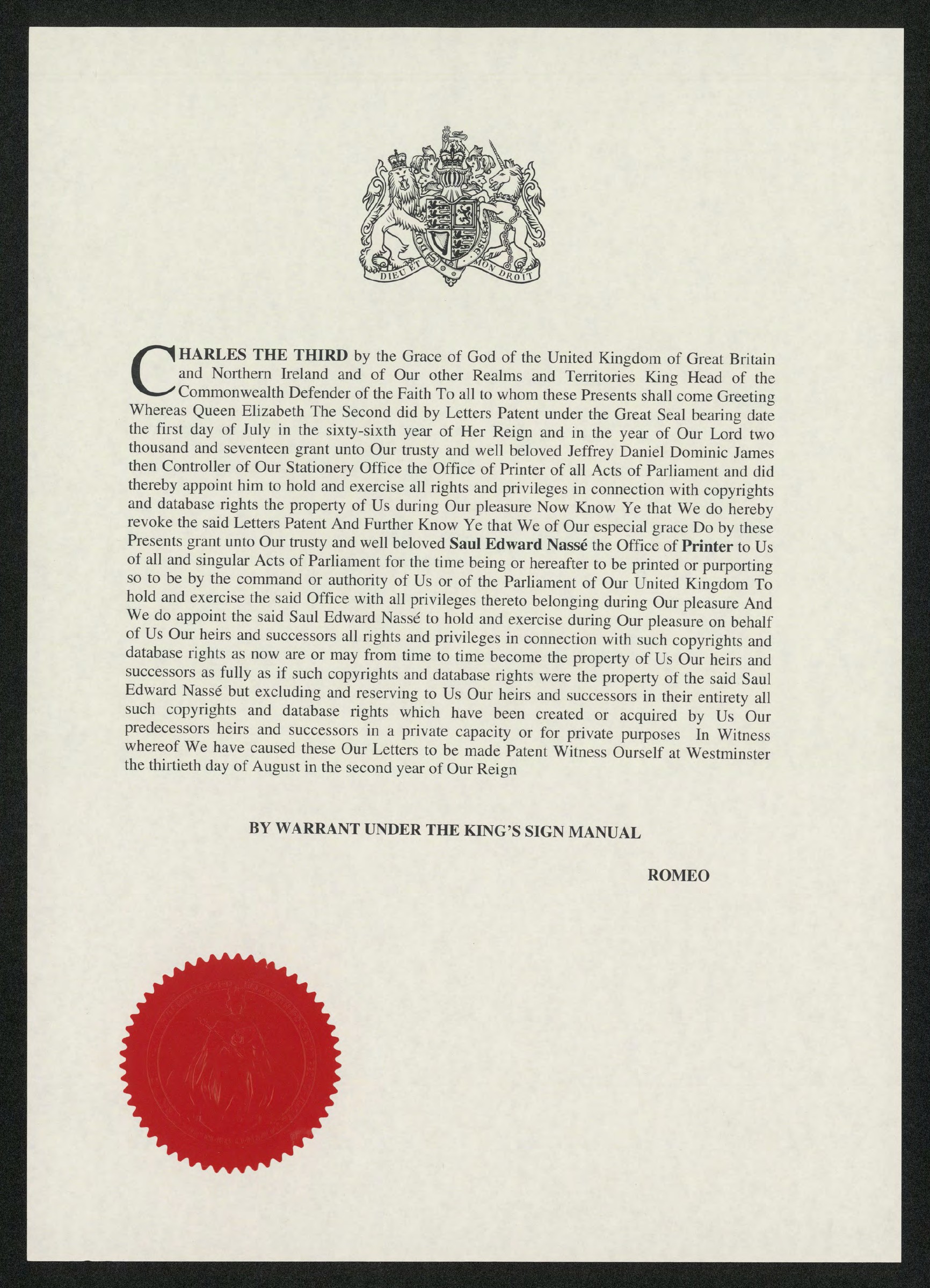
Who is Antonia Romeo? ROMEO is her surname; her full name is Antonia Rebecca Caroline Angharad Catherine Romeo, styled Dame Antonia Romeo DCB; at the date of this patent, she held the offices of Clerk of the Crown in Chancery and Permanent Secretary of the Ministry of Justice; both offices are recorded in the official 2024 honours account; her Ministry of Justice tenure, 2021–2025, is also recorded in her official biography;
Why is her name there? in rule 5 of the Crown Office (Preparation and Authentication of Documents Rules) Order 1988, it is written that the Clerk’s name must be “subscribed or printed” at the end, to authenticate that the document has passed through the Crown Office; that is the purpose of ROMEO here; read rule 5;
Printed name and signature; ROMEO is printed on this patent; its appearance does not establish that Antonia Romeo personally signed it by hand; the separate wording “BY WARRANT UNDER THE KING’S SIGN MANUAL” refers to the royal signature on the authorising warrant; the warrant itself is not shown in this image; the warrant procedure and its evidence;
Charles, the King and the Crown: the royal capacity
In X v Lord Advocate [2025] UKSC 44, paragraph 40, Lord Reed and Lord Burrows describe the Crown as a corporation sole, explain perpetual succession, and distinguish the monarch’s private capacity from the public office; in paragraphs 41–42 they discuss the contexts in which the Crown refers to the sovereign in an official capacity and to government;
The opening of the 30 August 2024 patent names Charles in his royal style; the grant is expressed in that royal capacity; the words concerning heirs and successors express continuation beyond the present officeholder;
read the judgment, paragraphs 40–42; read the 2024 patent; Maitland’s objections;
Maitland: the King, corporation sole and the meanings of Crown
Maitland described the medieval king as “every inch a man”, to whom immortality was not attributed; he then traced the later classification of kings and parsons as artificial persons and corporations sole; his historical comparison concerns the medieval king, and he discussed two-bodies arguments reported around the middle of the sixteenth century; PDF pages 115–118;
Here, immortal describes the continuity attributed to the represented royal office through successive monarchs; in X v Lord Advocate [2025] UKSC 44, paragraph 40, Lord Reed and Lord Burrows describe the Crown as a corporation sole with perpetual succession and explain the continuation of the office after the death of its holder; read paragraph 40; the royal capacity;
The land-ownership description has a separate source; in paragraph 4 of the Land Registration Act 2002 explanatory notes, the writers describe Crown as the only absolute owner of land in England and Wales, while everyone else holds an estate in land; this is the ownership attributed to Crown in that account, distinct from Charles’s private property; read paragraph 4; land, estate and title;
In The Crown as Corporation (1901), Maitland called applying the corporation-sole device to the King “still more abortive and infinitely more mischievous”; he criticised the inconsistent explanations of persons, bodies and capacities, and recorded that the separation of royal and private property had required legislation; Collected Papers, volume III, PDF page 118;
When discussing Letters Patent, he wrote: “On the face of formal records the King or Queen does it all.”; this describes the attribution in the record; preparation, signature and sealing are deeds of man kind; PDF pages 120–121;
He also examined the gradual substitution of Crown for King or Queen and its several meanings; he favoured an account of an organised community headed by the sovereign, and preferred the name Commonwealth; PDF page 121;
the fuller Crown-page discussion; return to Maitland’s objections; return to the argument;
The royal warrant, signature and countersignature
In section 2(1) of the Great Seal Act 1884, authority for passing an instrument under the Great Seal is attached to a royal sign-manual warrant countersigned by the Lord Chancellor, a Principal Secretary of State, the Lord High Treasurer, or two Treasury Commissioners;
The proviso preserves the existing procedure for instruments passed by the fiat, authority or directions of the Lord Chancellor, or otherwise without passing through another office; in section 2(2), preparation of the warrants is assigned to the Clerk of the Crown in Chancery;
These are the written procedural arrangements; the particular signatures and instructions for an individual patent are evidenced by its warrant and administrative record;
Paper, parchment, the seal and the printed name
In section 4 of the Crown Office Act 1877, provision is made for authorised seal impressions on embossed paper, wax, wafer or other material; equivalent validity is attributed to a document when the authorised impression is attached or embossed;
In the Crown Office rules of 1988, rule 2 concerns authentication by the Wafer Great Seal; rule 3 concerns printing and writing; rule 4 and Schedule 1 concern paper and parchment; in rule 5, authentication of passage through the Crown Office is attached to the Clerk of the Crown’s subscribed or printed name;
In Schedule 1, named categories include Letters Patent for suffragan bishops, the High Almoner, Master of the Temple, counsel, heralds and other appointments to office;
read the 1877 provision; read the 1988 rules and schedules; return to the table;
Two parliamentary appointments; two named corporations sole
In section 1(1) of the Parliamentary Corporate Bodies Act 1992, the Corporate Officer of the House of Lords is constituted as a corporation sole with perpetual succession, an official seal and capacity to sue and be sued; in section 1(2), the individual appointed by Letters Patent as Clerk of the Parliaments is designated as that Corporate Officer;
In section 2, the parallel arrangement concerns the Corporate Officer of the House of Commons; the individual appointed by Letters Patent as Under Clerk of the Parliaments, customarily called the Clerk of the House of Commons, is designated as that Corporate Officer;
The named corporations sole are the two Corporate Officers; the statutory connection runs from each individual’s appointment to the specified corporate capacity;
read section 1; read section 2; return to the parliamentary connection;